
About 80% of the world’s workforce—roughly 2.7 billion people—doesn't work at a desk. They run manufacturing lines, staff hotel front desks, manage retail floors, and stock warehouse shelves. Yet enterprise software spending largely ignores them: just 1% of tech budgets goes toward tools built for non-desk staff.
This oversight comes at a high price:
- Wasted Potential: Gallup data shows that when these employees feel disengaged, business profitability drops by 15% and turnover escalates.
- Slow Execution: When leadership and frontline staff aren't aligned, getting things done takes three times longer, making it nearly impossible to react quickly to urgent problems.
When large companies identified this void, giants like Meta (with Workplace), Google, and Microsoft attempted to adapt their ecosystems to these types of employees. However, the vast majority of these implementations failed or were underutilized due to three fundamental barriers:
- The need for corporate email: almost all these platforms were born under the assumption that the user has an ID based on an institutional email. Forcing operators to create email accounts they don't use regularly introduces massive, unnecessary licensing costs.
- Long and complex implementations: these projects often took a long time, required technical integrations with IT, and presented a steep learning curve for collaborators whose only requirement was to consult specific information.
- Prohibitive costs: monthly per-user licenses scale quickly when trying to cover thousands of plant operators or seasonal hospitality staff, affecting return on investment (ROI).
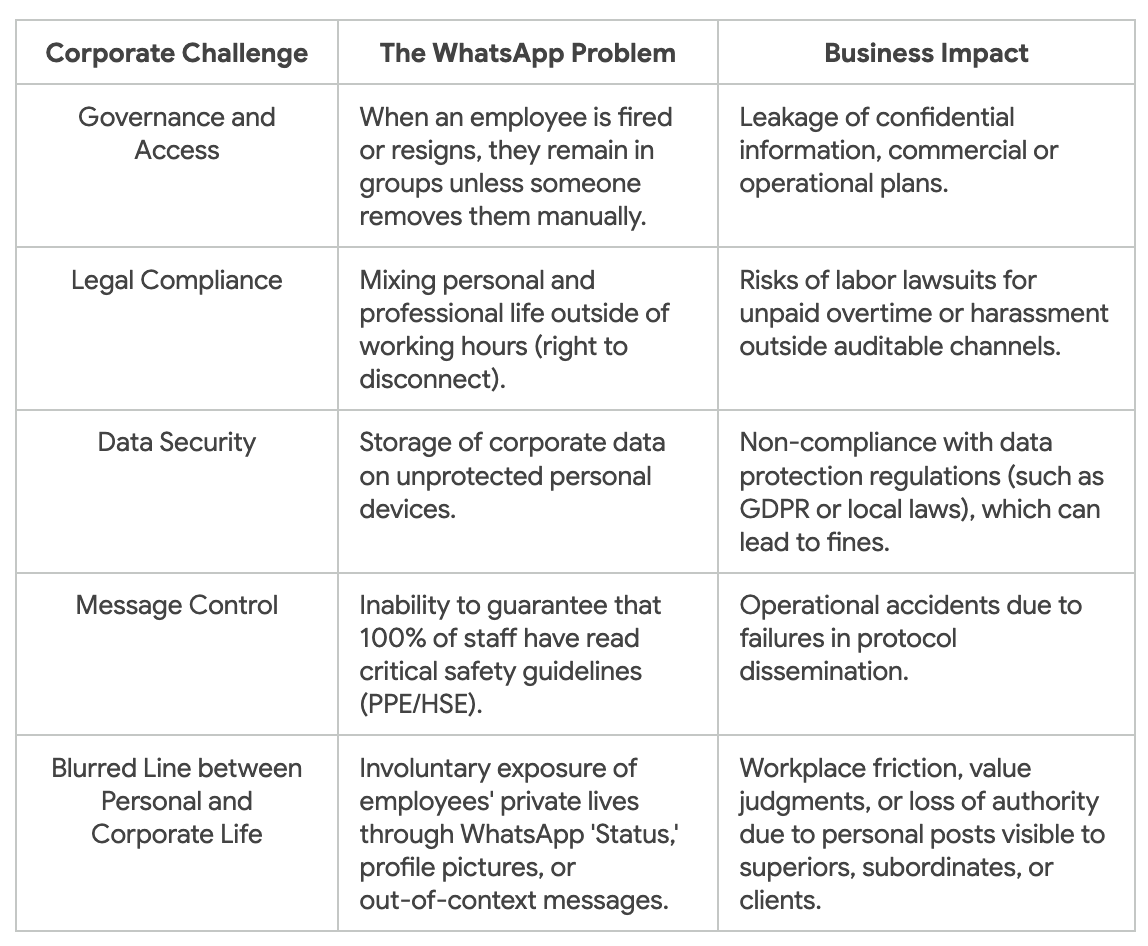
Informal messaging groups—like WhatsApp—often feel like a quick, efficient solution for team coordination. However, that perception of ease masks significant vulnerabilities, creating friction and serious liability the moment legal, security, or HR teams must intervene to manage compliance, data protection, and operational oversight.
Companies don't need another internal social network. They need targeted, secure communication built around operational realities:
- No corporate email required: Authentication should happen via worker ID, SMS, or QR codes.
- Automated sync: HR systems should automatically add or remove staff as payroll updates.
- Instant adoption: The interface needs to feel as simple as texting so employees use it from day one without training.
- Cost-Efficiency: A business model that understands the volumes of deskless personnel and allows communication to scale across the entire organization in a financially sustainable way.

Although many companies try to bridge the digital gap by assigning corporate email addresses to deskless employees—such as cashiers, laborers, or field personnel—email has significant limitations for daily operations.
While it is useful for formalizing information exchanges and documenting administrative workflows between departments, it is inefficient for daily operations: it does not allow for real-time critical alerts, nor does it centralize the documentation necessary for the job. This friction—where workers waste time searching for information in long email chains—leads them to use informal and insecure communication channels such as WhatsApp. Therefore, companies need communication alternatives that separate formal documentation from operational urgency.
Ignoring your deskless team isn't just an HR oversight—it's a massive hole in your operational security. Relying on informal chat groups or fighting with complex software that no one actually uses is a recipe for trouble.
InfoBox fixes this by giving you the security and oversight IT needs without making things hard for the people on the floor. It's simple to use, doesn't require a corporate email, and works on the devices your team already has in their pockets. It's the missing link for companies that need to get everyone on the same page, safely.

%20(1).svg)
.png)

.png)